
The IMA receives complaints as part of our duty to monitor and promote the implementation and application of the Citizens’ Rights parts of the Withdrawal and Separation Agreements.
The IMA received 119 complaints in 2024. Whilst this is lower than previous years, complaints continue to be key to helping us to understand issues citizens who feel their rights aren’t being upheld by public bodies are experiencing.
Out of the 74 complaints received that were within the IMA’s remit, 69% of complaints relate to new or ongoing issues being considered by the IMA. Information about our ongoing work is published on our Issues Log.
31% of complaints within the IMA’s remit, resulted in no further action. However, the complaints received indicate that there is a continuing need for EU citizens to be empowered to understand how to challenge when they feel things have gone wrong.
Below we detail the types of complaints we received in 2024, including the rights affected, the public bodies involved, and the nationalities of those who submitted complaints. The data relates to all complaints, both within and not within our remit.
Graph 1: Complaints received in 2024:
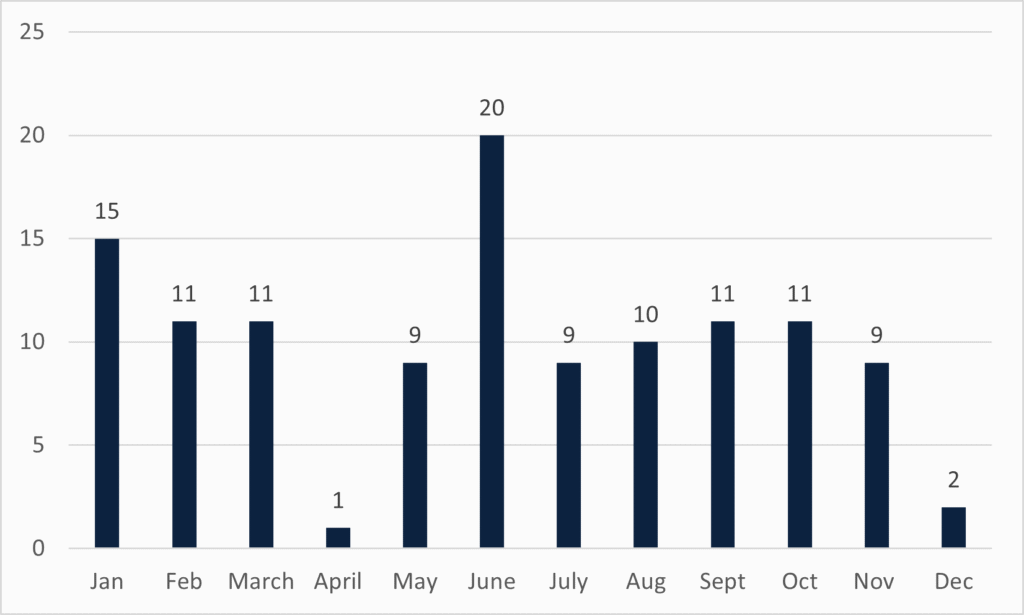
The IMA received 119 complaints from 1 January to 31 December 2024. We received the most complaints in June. 65% of the complaints received in June were in relation to the Home Office and the EU Settlement Scheme (EUSS).
Graph 2: Complaints received in 2024 vs. 2023, 2022 and 2021:
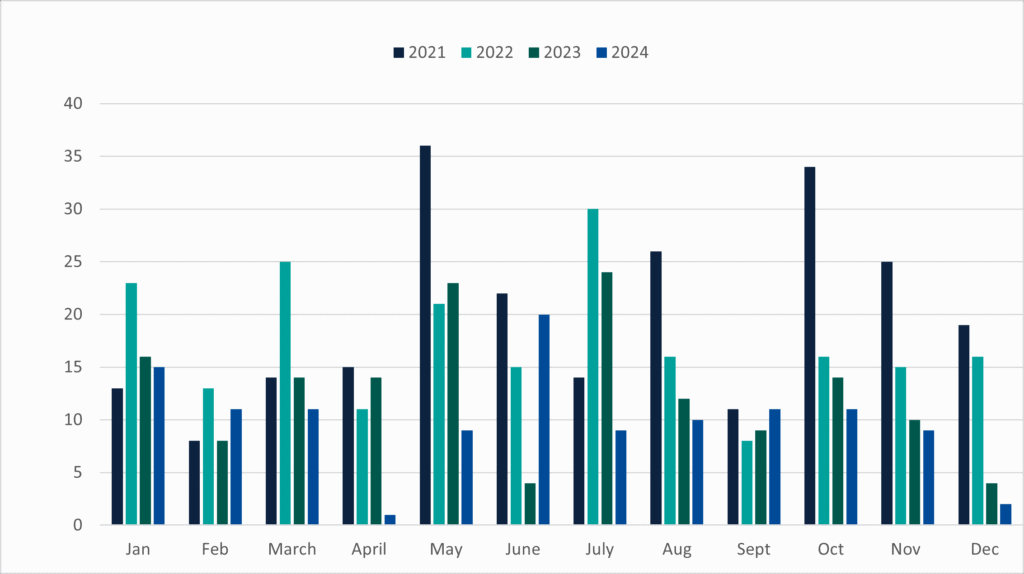
Graph 2 (above) shows how many complaints have been received in each year the IMA has been in operation. The dip in complaints received in April 2024 appears to be an isolated anomaly.
Graph 3: Complaints received by affected right:
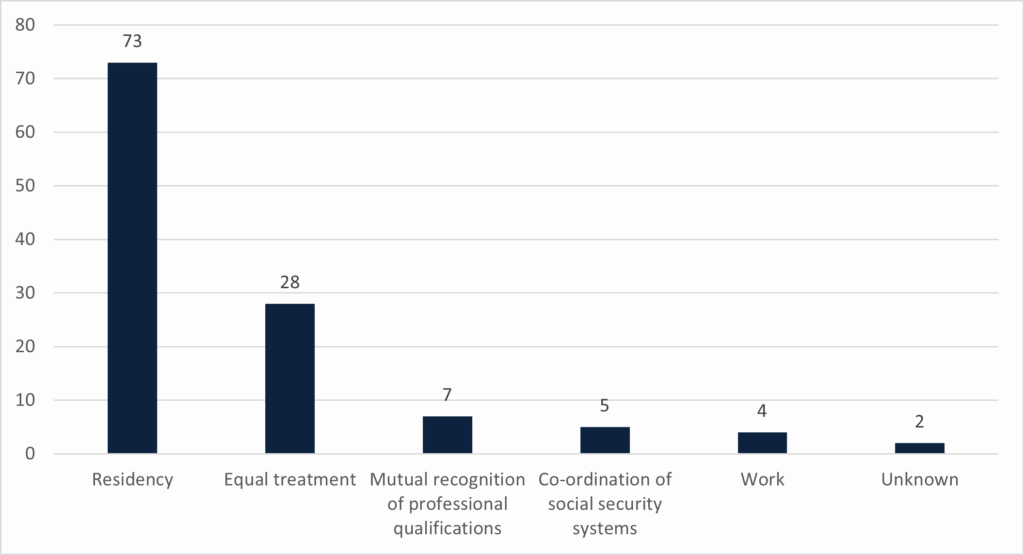
Graph 3 (above) shows how many complaints have been received in relation to each right.
The largest group of complaints received continue to relate to the right to reside, followed by equal treatment.
Residency – The right to reside includes the right to enter and exit the UK.
The complaints are mainly connected in some way to the UK Government’s EU Settlement Scheme (EUSS), run by the Home Office.
The issues raised in these types of complaints include:
- Citizens experiencing long wait times for their EUSS applications, beyond estimated application processing times advised by the Home Office. There is an open inquiry ongoing in relation to this: IMA launches new inquiry to investigate EU Settlement Scheme application delays.
- Changes to Border Force guidance allowing them to revoke pre settled status at the border in some circumstances.
- Difficulties in understanding EUSS absence rules. We have published information to help citizens understand the rules in relation to continuous residence: How absence from the UK may affect your EUSS status.
- Limitations of the Home Office passport Machine Readable Zone technology in relation to maiden names. This is currently subject to a monitoring period with the Home Office: EUSS and Maiden Names.
Work – The right to work, including self-employed work. It also applies to frontier workers; citizens who are employed or self-employed in the UK but live elsewhere.
The issues raised in these types of complaints include issues affecting the View and Prove service which inhibit citizens’ ability to access their proof of status. We are actively seeking further information on the impact of potential issues with the view and prove service with our stakeholders and citizens.
Qualifications – the right for qualifications which have already been recognised before 31 December 2020 (or were in the process of being recognised at that time), to continue to be recognised in the UK.
The issues raised in these types of complaints include an issue about recognition of EU qualifications to register with the regulator as a teacher.
Social Security – Individuals who have lived in both the UK and the EU before the end of the transition period can continue to access pensions, benefits, and other forms of social security. The transition period was the 11-month grace period agreed by the UK and the EU following the UK’s exit on 31 January 2020.
The issues raised in these complaints include difficulties applying for benefits, difficulties in applying for proof of national insurance contributions, and delays in receiving the proof of national insurance contributions.
Equal Treatment – EU and EEA EFTA citizens and their family members must be treated the same as UK and Gibraltarian citizens when it comes to accessing certain public services and some benefits.
The issues raised in these complaints include access to homelessness support for holders of PSS.
Graph 4: Public authorities named in complaints to the IMA in 2024:
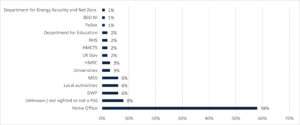
Graph 4 (above) demonstrates that most of the complaints reported to the IMA relate to the Home Office, followed by Department for Work and Pensions. The unknown figure reflects complaints received where there was no UK or Gibraltar public authority identified.
The most complaints about the Home Office were received from citizens marking their nationality as Italian, followed by British. The most complaints about Department for Work and Pensions were from German citizens followed by Italians.
Graph 5: Nationalities of complainants in 2024:
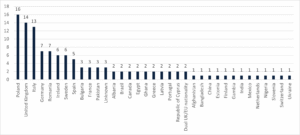
Graph 5 (above) shows the nationalities of those who made complaints to the IMA in 2024.We continue to receive complaints from a diverse range of nationalities. We did not receive any complaints from citizens of EEA EFTA countries. Where we refer to UK nationals this may include dual nationals. Additionally, unknown reflects those citizens who have not declared their nationality. Polish citizens submitted the most complaints about equal treatment followed by residency. UK citizens’ complaints were mostly about residency. Italian citizens’ complaints were mostly about residency followed by equal treatment
Graph 6: Where complainants reside:
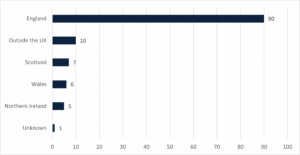
Graph 6 (above) shows where citizens complaining to the IMA in 2024 reside. Most complainants reside in England, this mirrors 2023,2022 and 2021. Those living outside the UK, include complainants who are joining relevant family members already residing in the UK. The most complained about right across each region was residency, ranging from 80% in Wales to 50% outside of the UK.