The difference between Pre-Settled Status (PSS) and Settled Status (SS)

Click the picture or the link  to view the image, share, or download it.

The difference between Pre-Settled Status (PSS) and Settled Status (SS)

The wording on the image is included below:

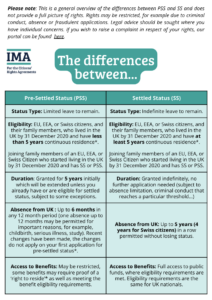
Please note: This is a general overview of the differences between PSS and SS and does not provide a full picture of rights. Rights may be restricted, for example due to criminal conduct, absence or fraudulent applications. Legal advice should be sought where you have individual concerns. If you wish to raise a complaint in respect of your rights, our portal can be found here.

The differences between…

Pre-Settled Status (PSS) Settled Status (SS)
Status Type: Limited leave to remain. Status Type: Indefinite leave to remain.
Eligibility: EU, EEA, or Swiss citizens, and their family members, who lived in the UK by 31 December 2020 and have less than 5 years continuous residence*.

Joining family members of an EU, EEA, or Swiss Citizen who started living in the UK by 31 December 2020 and has SS or PSS.

Eligibility: EU, EEA, or Swiss citizens, and their family members, who lived in the UK by 31 December 2020 and have at least 5 years continuous residence*.

Joining family members of an EU, EEA, or Swiss Citizen who started living in the UK by 31 December 2020 and has SS or PSS.

Duration: Granted for 5 years initially which will be extended unless you already have or are eligible for settled status, subject to some exceptions. Duration: Granted indefinitely, no further application needed (subject to absence limitation, criminal conduct that reaches a particular threshold…)
Absence from UK : Up to 6 months in any 12 month period (one absence up to 12 months may be permitted for important reasons, for example, childbirth, serious illness, study). Recent changes have been made, the changes do not apply on your first application for pre-settled status*. Absence from UK: Up to 5 years (4 years for Swiss citizens) in a row permitted without losing status.
Access to Benefits: May be restricted, some benefits may require proof of a ‘right to reside’* as well as meeting the benefit eligibility requirements. Access to Benefits: Full access to public funds, where eligibility requirements are met. Eligibility requirements are the same for UK nationals.
*‘Continuous residence’ generally means to be in the UK for at least 6 months in any 12-month period.
*Change to Absences: From 16 July 2025, changes have been made for PSS holders who are now permitted to retain their status and apply for settled status if they have lived in the UK for at least 30 months (2 and a half years) during the last 5 years. This change is not applicable to your first application for pre-settled status.
*‘Right to reside’ is a way of describing the conditions of residence, these include being a worker or a retained worker (for example, on maternity leave), being self-employed, having sufficient resources (for example, retired or a student) and comprehensive sickness insurance, being a family member of someone with PSS or SS who meets these conditions, or having already obtained SS

Your Pension Rights as an EU Citizen in the UK

Click the picture or the link to view the image, share, or download it.
Your Pension Rights as an EU Citizen in the UK

The wording on the image is included below:

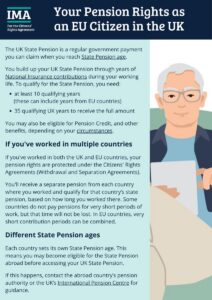
Your Pension Rights as an EU Citizen in the UK

The UK State Pension is a regular government payment you can claim when you reach State Pension age.

You build up your UK State Pension through years of National Insurance contributions during your working life. To qualify for the State Pension, you need:

  • at least 10 qualifying years(these can include years from EU countries)
  • 35 qualifying UK years to receive the full amount

You may also be eligible for Pension Credit, and other benefits, depending on your circumstances.

If you’ve worked in multiple countries

If you’ve worked in both the UK and EU countries, your pension rights are protected under the Citizens’ Rights Agreements (Withdrawal and Separation Agreements).

You’ll receive a separate pension from each country where you worked and qualify for that country’s state pension, based on how long you worked there. Some countries do not pay pensions for very short periods of work, but that time will not be lost. In EU countries, very short contribution periods can be combined.

Different State Pension ages

Each country sets its own State Pension age. This means you may become eligible for the State Pension abroad before accessing your UK State Pension.

If this happens, contact the abroad country’s pension authority or the UK’s International Pension Centre for guidance.

How to access your State Pension

If retiring in the UK:

If retiring abroad:

  • if you have not worked in another country since leaving the UK, apply directly to the UK’s International Pension Centre
  • if you have worked in another country since leaving the UK, apply through the country you most recently worked in

TOP TIPS

Apply for your pension at least 6 months in advance. It can take time for countries to share information, and small differences in your personal details may cause delays. Don’t worry, this will not affect your pension entitlement.

Keep your payslips and P60s safe. If there’s a gap in your National Insurance record, you can ask your employer or pension scheme to correct it using these documents.

Get help and advice

Visit GOV.UK for guidance on pension eligibility.

Read the EU Commission’s Q&A document for EU citizens protected by the Withdrawal Agreement.

Get more help from the Money and Pensions Service

Make a complaint to the Pension Ombudsman or the Gibraltar Financial Services Commission.

If you’ve experienced issues with accessing your pension, you can report a complaint via our complaints portal, or tell us about your experience on our Your story page.

Find out more about pensions on our FAQs page.