Voting eligibility for citizens from EU countries

Click the picture or the link  to view the image, share, or download it.

Voting eligibility for citizens from EU countries

The wording on the image is included below:

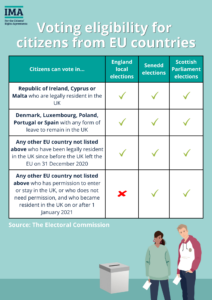
Voting eligibility for citizens from EU countries

Table 1
Citizens can vote in… England local elections Senedd elections Scottish Parliament elections
Republic of Ireland, Cyprus or Malta who are legally resident in the UK Yes Yes Yes
Denmark, Luxembourg, Poland, Portugal or Spain with any form of leave to remain in the UK Yes Yes Yes
Any other EU country not listed above who have been legally resident in the UK since before the UK left the EU on 31 December 2020 Yes Yes Yes
Any other EU country not listed above who has permission to enter or stay in the UK, or who does not need permission, and who became resident in the UK on or after 1 January 2021 No Yes Yes

Source: The Electoral Commission

What is a share code?

Click the picture or the link  to view the image, share, or download it.

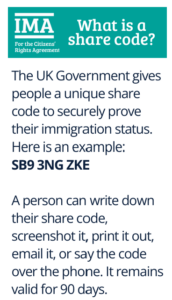
Share code info card

The wording on the image is included below:

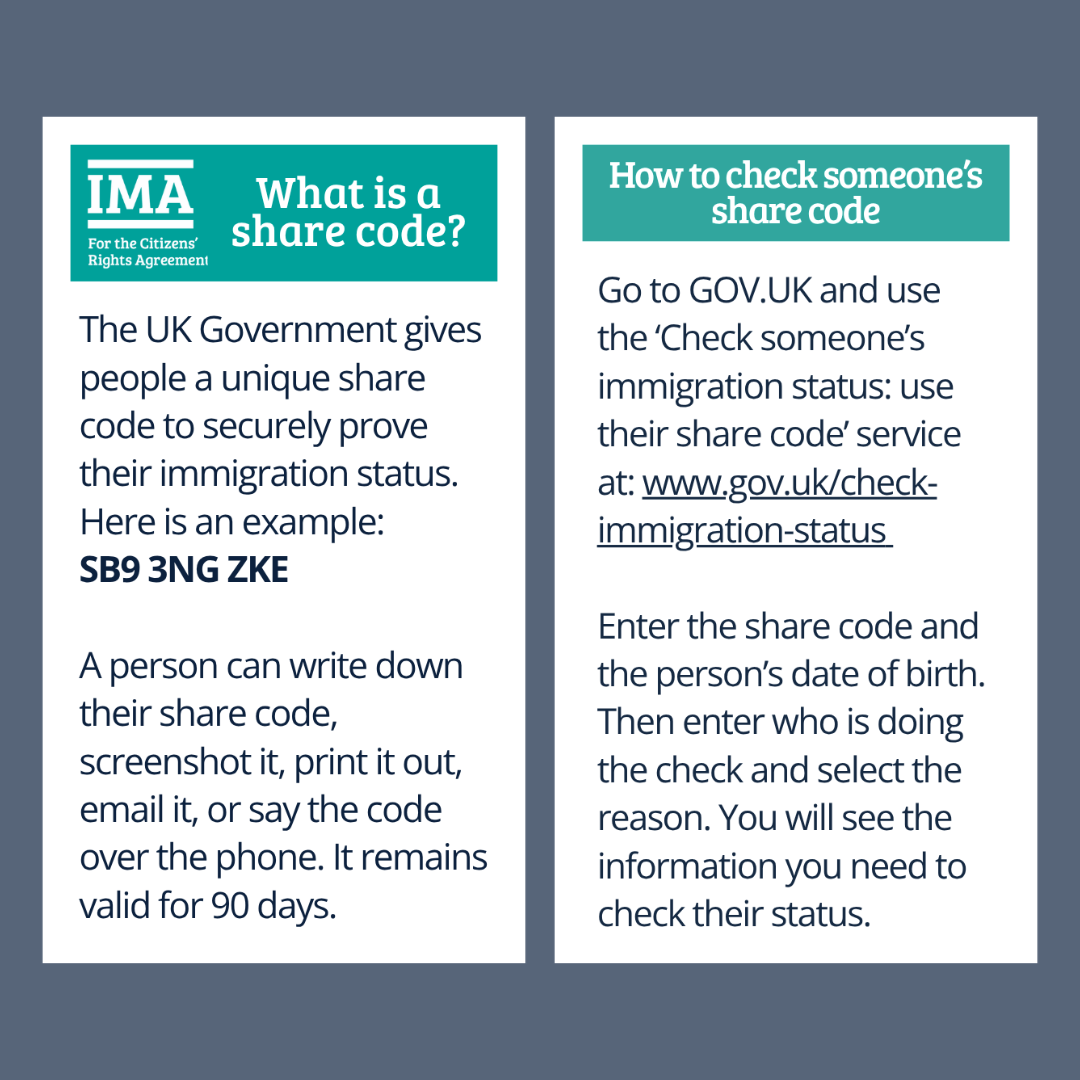
What is a share code?

The UK Government gives people a unique share code to securely prove their immigration status.
Here is an example: SB9 3NG ZKE
A person can write down their share code, screenshot it, print it out, email it, or say the code over the phone. It remains valid for 90 days.

How to check someone’s share code

Go to GOV.UK and use the ‘Check someone’s immigration status: use their share code’ service at: www.gov.uk/check immigration-status
Enter the share code and the person’s date of birth. Then enter who is doing the check and select the
reason. You will see the information you need to check their status.

Secure your child’s rights in the UK

Click the picture or the link to view the image, share, or download it.
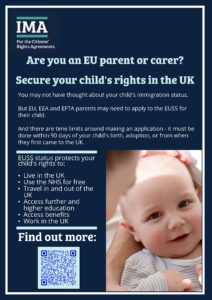
Secure child’s rights leaflet

The wording on the image is included below:

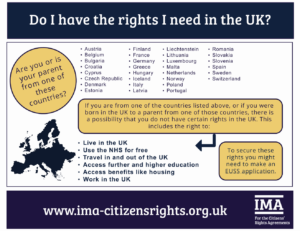
Are you an EU parent or carer?

Secure your child’s rights in the UK

You may not have thought about your child’s immigration status.

But EU, EEA and EFTA parents may need to apply to the EUSS for their child.

And there are time limits around making an application – it must be done within 90 days of your child’s birth, adoption, or from when they first came to the UK.

EUSS status protects your child’s rights to:

  • Live in the UK
  • Use the NHS for free
  • Travel in and out of the UK
  • Access further and higher education
  • Access benefits
  • Work in the UK


Automatic conversions to settled status: Everything you need to know

Click the picture or the link  to view the image, share, or download it.

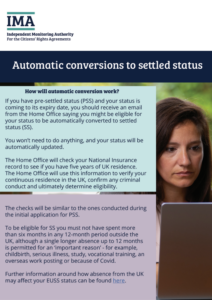
Automatic conversions to settled status Everything you need to know

The wording on the image is included below:

Automatic conversions to settled status

How will automatic conversion work?

If you have pre-settled status (PSS) and your status is coming to its expiry date, you should receive an email from the Home Office saying you might be eligible for your status to be automatically converted to settled status (SS).

You won’t need to do anything, and your status will be automatically updated.

The Home Office will check your National Insurance record to see if you have five years of UK residence. The Home Office will use this information to verify your continuous residence in the UK, confirm any criminal conduct and ultimately determine eligibility.

The checks will be similar to the ones conducted during the initial application for PSS.

To be eligible for SS you must not have spent more than six months in any 12-month period outside the UK, although a single longer absence up to 12 months is permitted for an ‘important reason’ – for example, childbirth, serious illness, study, vocational training, an overseas work posting or because of Covid.

Further information around how absence from the UK may affect your EUSS status can be found here.

What you need to do

• PSS holders are encouraged to keep their UKVI account details up to date

• Check your emails regularly as the Home Office may contact you

• Update your UKVI account if you get a new passport or national ID card

If you are not selected for automatic upgrade, and your expiry of PSS is approaching, the Home Office will automatically extend your PSS by five years.

It is also strongly advised that PSS holders familiarise themselves with the documents set out by the Home Office, which show your eligibility. All the documents you can and can’t use as evidence of residence can be found here.

Other useful resources

For anyone seeking further advice or information about issues they may be facing, you can find details of various organisations including charities, citizens’ rights groups and public bodies that may be able to help you on our website.


Change to Absences

Click the picture or the link  to view the image, share, or download it.

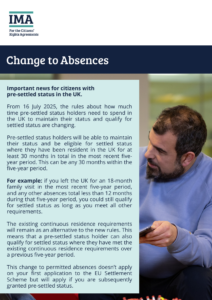
Change to Absences

The wording on the image is included below:

Change to Absences

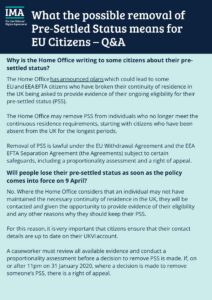
Important news for citizens with pre-settled status in the UK.

From 16 July 2025, the rules about how much time pre-settled status holders need to spend in the UK to maintain their status and qualify for settled status are changing.

Pre-settled status holders will be able to maintain their status and be eligible for settled status where they have been resident in the UK for at least 30 months in total in the most recent five year period. This can be any 30 months within the five-year period.

For example: if you left the UK for an 18-month family visit in the most recent five-year period, and any other absences total less than 12 months during that five-year period, you could still qualify for settled status as long as you meet all other requirements.

The existing continuous residence requirements will remain as an alternative to the new rules. This means that a pre-settled status holder can also qualify for settled status where they have met the existing continuous residence requirements over a previous five-year period.

This change to permitted absences doesn’t apply on your first application to the EU Settlement Scheme but will apply if you are subsequently granted pre-settled status.

FAQs: Absences

My first application to the EU Settlement Scheme is yet to be decided, how will the change affect me?

The change only applies to pre-settled status holders. It does not apply to first-time applicants to the scheme. If you are granted pre-settled status, it will apply to you in the same way as it does to all other pre-settled status holders when they apply or are automatically considered for settled status.

I have settled status, do the new rules affect me?

No, the change will only apply to pre-settled status holders. Settled status holders can be absent from the UK for up to 5 years in a row without losing status.

I am a crown servant, what if my overseas posting is longer than 30 months?

The change does not affect any of the existing circumstances in which an absence from the UK of more than 6 months in a 12-month period will be permitted.

Will the new rules apply when my case is considered under the automated process?

It depends on when your case is considered. The Home Office has told us that they will not be able to automatically grant status to pre-settled status holders who meet the new rules until later this year as they need to update systems to reflect the change.

Pre-settled status holders can make an application for settled status in the usual way, as soon as they are eligible for it. On or after 16 July, applications will be considered under the revised rules.

My application for settled status has been refused because I have broken my continuity of residence, but I think I would qualify under the new rules, what should I do?

If your pre-settled status has not lapsed, been cancelled, curtailed or been invalidated you can make a new application for settled status. Applications made for settled status on or after 16 July will be considered under the revised rules. Alternatively, you can wait until your case is reviewed under
the automated process.

I thought pre-settled status automatically lapsed after two years absence from the UK?

Whether your pre-settled status has automatically lapsed will depend on the dates of your absence. Prior to 21 May 2024, pre-settled status would automatically lapse if the holder spent more than two continuous years outside the UK. Changes were made to legislation to remove this provision, but it was not retrospective.

Pre-settled and settled status automatically lapse after a continuous absence of over five years, no matter when this absence occurred. Currently, the new rules do not apply to citizens whose pre-settled status has lapsed. This is something we are continuing to discuss with the Home Office.

Will I need to explain why I have been absent?

No, you will only need to show that you have not been absent for more than 30 months in the most recent five-year period.

If you have been absent for more than 30 months in the most recent five year period and you think you’re still eligible for settled status under the existing continuous residence requirements, you will need to provide evidence regarding the reasons for your absences to the Home Office.

Report your concerns

  • Complaints portal
  • Your story page

Learn more about your rights.

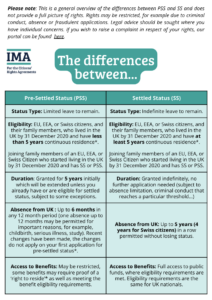
The difference between Pre-Settled Status (PSS) and Settled Status (SS)

Click the picture or the link  to view the image, share, or download it.

The difference between Pre-Settled Status (PSS) and Settled Status (SS)

The wording on the image is included below:

Please note: This is a general overview of the differences between PSS and SS and does not provide a full picture of rights. Rights may be restricted, for example due to criminal conduct, absence or fraudulent applications. Legal advice should be sought where you have individual concerns. If you wish to raise a complaint in respect of your rights, our portal can be found here.

The differences between…

Pre-Settled Status (PSS) Settled Status (SS)
Status Type: Limited leave to remain. Status Type: Indefinite leave to remain.
Eligibility: EU, EEA, or Swiss citizens, and their family members, who lived in the UK by 31 December 2020 and have less than 5 years continuous residence*.

Joining family members of an EU, EEA, or Swiss Citizen who started living in the UK by 31 December 2020 and has SS or PSS.

Eligibility: EU, EEA, or Swiss citizens, and their family members, who lived in the UK by 31 December 2020 and have at least 5 years continuous residence*.

Joining family members of an EU, EEA, or Swiss Citizen who started living in the UK by 31 December 2020 and has SS or PSS.

Duration: Granted for 5 years initially which will be extended unless you already have or are eligible for settled status, subject to some exceptions. Duration: Granted indefinitely, no further application needed (subject to absence limitation, criminal conduct that reaches a particular threshold…)
Absence from UK : Up to 6 months in any 12 month period (one absence up to 12 months may be permitted for important reasons, for example, childbirth, serious illness, study). Recent changes have been made, the changes do not apply on your first application for pre-settled status*. Absence from UK: Up to 5 years (4 years for Swiss citizens) in a row permitted without losing status.
Access to Benefits: May be restricted, some benefits may require proof of a ‘right to reside’* as well as meeting the benefit eligibility requirements. Access to Benefits: Full access to public funds, where eligibility requirements are met. Eligibility requirements are the same for UK nationals.
*‘Continuous residence’ generally means to be in the UK for at least 6 months in any 12-month period.
*Change to Absences: From 16 July 2025, changes have been made for PSS holders who are now permitted to retain their status and apply for settled status if they have lived in the UK for at least 30 months (2 and a half years) during the last 5 years. This change is not applicable to your first application for pre-settled status.
*‘Right to reside’ is a way of describing the conditions of residence, these include being a worker or a retained worker (for example, on maternity leave), being self-employed, having sufficient resources (for example, retired or a student) and comprehensive sickness insurance, being a family member of someone with PSS or SS who meets these conditions, or having already obtained SS

UKVI and Share codes: How to prove your status digitally

Click the picture or the link  to view the image, share, or download it.

UKVI and Share codes How to prove your status digitally

The wording on the image is included below:

UKVI and Share codes: How to prove your status digitally

A UK Visas and Immigration (UKVI) account is a secure online account that holds your immigration details. It lets you view and prove your immigration status online and keep your details up to date. You can share your immigration status with others by generating a share code. Your UKVI account holds your eVisa, so you may hear both terms used to mean the same thing.

Do I have a UKVI account?

When you are granted either Pre-Settled (PSS) or Settled status (SS) under the EU Settlement Scheme (EUSS), your UKVI account will be created as part of the application process. If you have an outstanding application to the EUSS and you have been told that you have a digital certificate of application (CoA), you will have a UKVI account and be able to use the View and Prove service. The Home Office does
not consider a CoA to be an eVisa document. You can find out more about travelling with a CoA here.

How to access your UKVI account

You can access your UKVI account to update some of your personal details, to generate a share code, or to view your eVisa.

To access your UKVI account, you will need to login with the following details:

  • the identity document you used when creating your account (passport or national ID card)
  • your date of birth
  • phone number or email address you used when creating your account (if you have lost access to your phone or email, you can recover your UKVI account here)

The Home Office has made a helpful video guide.

What is a share code?

A share code is a unique combination of letters and numbers that lets you prove your immigration status. It will look like a combination of letters and numbers. Here is an example share code:

SB9 3NG ZKE

You can write down your share code, screenshot it, print it out, email it, or say the code over the phone.

How to generate your share code

  • login to your UKVI account
  • choose from the list on screen the reason you are sharing your information (for example, to prove your right to work, or to travel)- it is important to choose the correct reason
  • you will then see a preview of the information that will be sharedwhich summarises your immigration status
  • click ‘create share code’

When you travel with PSS or SS

Your eVisa will be checked automatically when you show your identity document to a carrier or border control. Home Office guidance states that you may also be asked to provide additional proof of your immigration status, such as a share code.

Once generated, a share code is valid for 90 days. If you generate your share code before travelling, make sure you do it within 90 days of your return to the UK and carry an offline copy in case you have trouble accessing WIFI at the border. You may want to also bring a copy of the preview page summarising your immigration status so you can easily double check all your details when speaking to carriers and border control.

It is also important that before travelling, you check that:

  • your eVisa shows the correct details
  • your UKVI account is up to date with your most recent passport and personal details
  • your details exactly match the passenger information yougive to your carrier

You will need to make sure that the passport or travel
document you’re using for your journey is added to your UKVI
account.

Keep your details up to date

If any of your identity documents or personal details change, you will need to make sure you update your UKVI account. This will allow you to continue to access your account and prove your immigration status.

Securing your child’s rights fact sheet

Click the picture or the link  to view the image, share, or download it.

Securing your child’s rights fact sheet

The wording on the image is included below:

Securing your child’s rights in the UK as an EU, EEA or EFTA citizen

If you are an EU or EEA EFTA parent living in the UK, there is a possibility that your child does not have certain rights.

Rights are not automatically given to every child that is born or adopted in the UK.

And children do not automatically have the same immigration status as their parents.

You may have to make an EUSS application on behalf of your child to secure their immigration status and guarantee their rights in the UK.

These rights are important. They mean that your child can:

• live in the UK
• use the NHS for free
• work here
• travel in and out of the UK
• access further or higher education
• access benefits

This fact sheet should help you check whether you should make an EUSS application for your child, as well as answer questions about making such an application.

Do I need to make an EUSS application for my child?

Use the below to help you understand whether your child needs an EUSS application. For the latest rules around this matter, go to Gov.UK.

If your child was born in the UK on or after 1 July 2021 and you can answer YES to any of the three questions below when considering the circumstances at the time of your child’s birth, then your child is a British citizen and already has the rights they need. *

  • Do you or does the child’s other parent have settled status?
  • Were you or was the other parent a British citizen when the child was born?
  • Do you have pre-settled status and were you living in the UK by 31 December 2020 and had been in the UK for five years continuously before your child was born, during which time were you working (or looking for work for up to three months), studying or self-sufficient?

If you CANNOT answer yes to any of the above questions, then your child may need EUSS status to secure certain rights in the UK.

Read on for our FAQs around this.

**There may be other situations whereby your child is a British citizen. Go to Gov.UK.

FAQs

Is my child eligible for EUSS status?

If you, your spouse or civil partner, or your child is from the EU, Switzerland, Norway, Iceland or Liechtenstein and you lived in the UK by 31 December 2020, you can apply to the EUSS for your child if they
are under 21 years old. Or, they were under 21 when they got pre-settled status and want to switch to settled status.

When do I need to make an application for my child?

An application should be made within the time limit set out by the Home Office. If your child already lived in the UK by 31 December 2020, the deadline for applications was 30 June 2021. If your child was born or adopted in the UK after 30 June 2021, or they first arrived in the UK after 31 December 2020, you must apply within 90 days of their birth, adoption, or first arrival in the UK. If you’ve missed the deadline, you may be able to submit a late application.

If my child has pre-settled status under EUSS will they be automatically upgraded to settled status?

The Home Office has begun automatically converting some people’s status from pre-settled to settled. At the moment, this isn’t being done for children. A child who is under 21 will need to apply to the EUSS to convert their status from pre-settled to settled.

How do I make an EUSS application on behalf of my child?

Information about how to apply to the EU Settlement Scheme can be found on Gov.UK. When making an
application, you will need to prove:

  • your child’s identity
  • your relationship to your child
  • your immigration status
  • when your child was born or adopted
  • when your child started living here – evidence that they were here in the last six months of 2020 if they were living in the UK by 31 December 2020
  • your child’s continuous residence

Parents can use their child’s email address if they have one, or their own email address, to make an EUSS application for their child. You can link your child’s application to yours. If your application is successful, your child will get the status they are eligible for – this may be different to yours.

Contact Gov. UK’s Resolution Centre if you do not have any of the listed documents as you may be unable to use the online service. There is a postal option available too.

FAQs

Can I make an application for my child even if I am not eligible for EUSS status?

Yes. If your child is eligible for EUSS, you can still make an application for them even if you are not eligible for the scheme.

Can my child make an application themselves?

Yes, if your child is able to submit an application, they can do it themselves. You are not obliged to do it for them.

I have pre settled status as a joining family member, can my child apply to EUSS?

If someone else sponsored your application to the EUSS, for example, your brother, you won’t be able to sponsor your child’s application. Your child may be able to apply if their other parent has pre-settled status and started living in the UK before 31 December 2020.

If your child was born in the UK and at the time of their birth, the other parent was British or had settled status (or had pre-settled status and had acquired permanent residence rights under the Withdrawal
Agreements), then your child will be British.

You need to take action to secure your child’s immigration status. It is important to get good quality, regulated immigration advice. A list of organisations that may be able help you are included on the IMA
Website Useful Contacts.

What happens if I miss the deadline to apply for my child?

If you’ve missed the deadline, you may still be able to submit an application. You will need to show ‘reasonable grounds’ for why you missed the deadline. There are a number of circumstances where you may
still be eligible. Details are on Gov.UK.

More Information

To ensure you get good quality advice you should always seek advice from regulated immigration professional or legal advisors.

Information about how to apply to the EU Settlement Scheme can be found on Gov.UK.

A list of organisations which may be able to help you can be found on the IMA website.

EUSS status automation process – What you need to know

Click the picture or the link  to view the image, share, or download it.

EUSS status automation process – What you need to know

The wording on the image is included below:

EUSS status automation process – What you need to know

Successful applicants to the EU Settlement Scheme (EUSS) receive either:

  • Pre-settled status (PSS) – limited leave to remain (usually if resident in the UK for less than five years)
  • Settled status (SS) – indefinite leave to remain (usually if resident for at least five years)

In January 2025, The Home Office introduced a new process called Automation

Automation automatically converts PSS holders who are eligible for SS. This means individuals covered by this process will no longer need to submit a second application under the EUSS

The Home Office already extends PSS for individuals who continue to meet the conditions of their grant of status and whose status is due to expire by an additional five years

This ensures that rights are maintained during Automation PSS holders do not need to wait to be converted to settled status by Automation. They can still apply for it as soon as they are eligible

Who is not eligible for Automation?

At this time children and joining family members will not be included in the Automation process.

How will it work?

Checks are automatic, using government-held data, for example:

  • To confirm continued UK residence
  • Check for any criminal conduct
  • These checks are the same as when you first applied

What do you need to do?

Nothing – if eligible, you’ll be converted automatically

You should receive an email notification:

  • When you are considered for automation
  • If the Home Office cannot grant settled status

If you are automatically moved from PSS to SS, you should receive an email confirming your status

You can still apply manually anytime at: www.gov.uk/eusettlementscheme

Additional information

Further information can be found here.

Your Pension Rights as an EU Citizen in the UK

Click the picture or the link to view the image, share, or download it.

Your Pension Rights as an EU Citizen in the UK

The wording on the image is included below:

Your Pension Rights as an EU Citizen in the UK

The UK State Pension is a regular government payment you can claim when you reach State Pension age.

You build up your UK State Pension through years of National Insurance contributions during your working life. To qualify for the State Pension, you need:

  • at least 10 qualifying years(these can include years from EU countries)
  • 35 qualifying UK years to receive the full amount

You may also be eligible for Pension Credit, and other benefits, depending on your circumstances.

If you’ve worked in multiple countries

If you’ve worked in both the UK and EU countries, your pension rights are protected under the Citizens’ Rights Agreements (Withdrawal and Separation Agreements).

You’ll receive a separate pension from each country where you worked and qualify for that country’s state pension, based on how long you worked there. Some countries do not pay pensions for very short periods of work, but that time will not be lost. In EU countries, very short contribution periods can be combined.

Different State Pension ages

Each country sets its own State Pension age. This means you may become eligible for the State Pension abroad before accessing your UK State Pension.

If this happens, contact the abroad country’s pension authority or the UK’s International Pension Centre for guidance.

How to access your State Pension

If retiring in the UK:

If retiring abroad:

  • if you have not worked in another country since leaving the UK, apply directly to the UK’s International Pension Centre
  • if you have worked in another country since leaving the UK, apply through the country you most recently worked in

TOP TIPS

Apply for your pension at least 6 months in advance. It can take time for countries to share information, and small differences in your personal details may cause delays. Don’t worry, this will not affect your pension entitlement.

Keep your payslips and P60s safe. If there’s a gap in your National Insurance record, you can ask your employer or pension scheme to correct it using these documents.

Get help and advice

Visit GOV.UK for guidance on pension eligibility.

Read the EU Commission’s Q&A document for EU citizens protected by the Withdrawal Agreement.

Get more help from the Money and Pensions Service

Make a complaint to the Pension Ombudsman or the Gibraltar Financial Services Commission.

If you’ve experienced issues with accessing your pension, you can report a complaint via our complaints portal, or tell us about your experience on our Your story page.

Find out more about pensions on our FAQs page.