What is a share code?

Click the picture or the link  to view the image, share, or download it.

Share code info card

The wording on the image is included below:

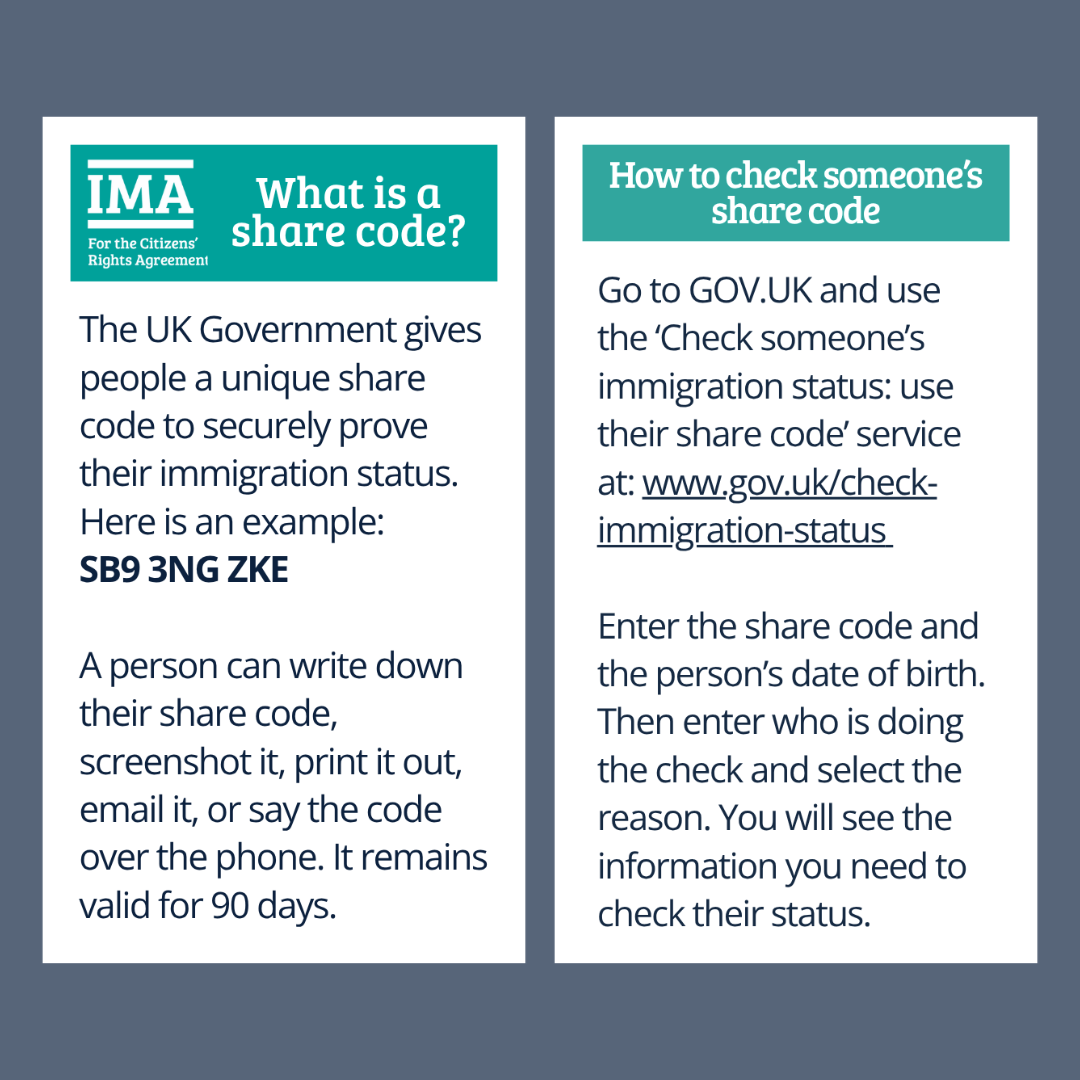
What is a share code?

The UK Government gives people a unique share code to securely prove their immigration status.
Here is an example: SB9 3NG ZKE
A person can write down their share code, screenshot it, print it out, email it, or say the code over the phone. It remains valid for 90 days.

How to check someone’s share code

Go to GOV.UK and use the ‘Check someone’s immigration status: use their share code’ service at: www.gov.uk/check immigration-status
Enter the share code and the person’s date of birth. Then enter who is doing the check and select the
reason. You will see the information you need to check their status.

Change to Absences

Click the picture or the link  to view the image, share, or download it.

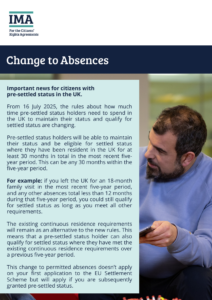
Change to Absences

The wording on the image is included below:

Change to Absences

Important news for citizens with pre-settled status in the UK.

From 16 July 2025, the rules about how much time pre-settled status holders need to spend in the UK to maintain their status and qualify for settled status are changing.

Pre-settled status holders will be able to maintain their status and be eligible for settled status where they have been resident in the UK for at least 30 months in total in the most recent five year period. This can be any 30 months within the five-year period.

For example: if you left the UK for an 18-month family visit in the most recent five-year period, and any other absences total less than 12 months during that five-year period, you could still qualify for settled status as long as you meet all other requirements.

The existing continuous residence requirements will remain as an alternative to the new rules. This means that a pre-settled status holder can also qualify for settled status where they have met the existing continuous residence requirements over a previous five-year period.

This change to permitted absences doesn’t apply on your first application to the EU Settlement Scheme but will apply if you are subsequently granted pre-settled status.

FAQs: Absences

My first application to the EU Settlement Scheme is yet to be decided, how will the change affect me?

The change only applies to pre-settled status holders. It does not apply to first-time applicants to the scheme. If you are granted pre-settled status, it will apply to you in the same way as it does to all other pre-settled status holders when they apply or are automatically considered for settled status.

I have settled status, do the new rules affect me?

No, the change will only apply to pre-settled status holders. Settled status holders can be absent from the UK for up to 5 years in a row without losing status.

I am a crown servant, what if my overseas posting is longer than 30 months?

The change does not affect any of the existing circumstances in which an absence from the UK of more than 6 months in a 12-month period will be permitted.

Will the new rules apply when my case is considered under the automated process?

It depends on when your case is considered. The Home Office has told us that they will not be able to automatically grant status to pre-settled status holders who meet the new rules until later this year as they need to update systems to reflect the change.

Pre-settled status holders can make an application for settled status in the usual way, as soon as they are eligible for it. On or after 16 July, applications will be considered under the revised rules.

My application for settled status has been refused because I have broken my continuity of residence, but I think I would qualify under the new rules, what should I do?

If your pre-settled status has not lapsed, been cancelled, curtailed or been invalidated you can make a new application for settled status. Applications made for settled status on or after 16 July will be considered under the revised rules. Alternatively, you can wait until your case is reviewed under
the automated process.

I thought pre-settled status automatically lapsed after two years absence from the UK?

Whether your pre-settled status has automatically lapsed will depend on the dates of your absence. Prior to 21 May 2024, pre-settled status would automatically lapse if the holder spent more than two continuous years outside the UK. Changes were made to legislation to remove this provision, but it was not retrospective.

Pre-settled and settled status automatically lapse after a continuous absence of over five years, no matter when this absence occurred. Currently, the new rules do not apply to citizens whose pre-settled status has lapsed. This is something we are continuing to discuss with the Home Office.

Will I need to explain why I have been absent?

No, you will only need to show that you have not been absent for more than 30 months in the most recent five-year period.

If you have been absent for more than 30 months in the most recent five year period and you think you’re still eligible for settled status under the existing continuous residence requirements, you will need to provide evidence regarding the reasons for your absences to the Home Office.

Report your concerns

  • Complaints portal
  • Your story page

Learn more about your rights.

CoA and Travel What EU Citizens Need to Know

Click the picture or the link  to view the image, share, or download it.

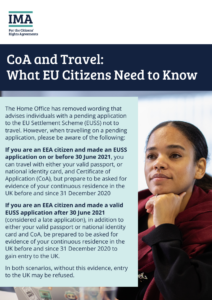
CoA and Travel What EU Citizens Need to Know

The wording on the image is included below:

CoA and Travel: What EU Citizens Need to Know

The Home Office has removed wording that advises individuals with a pending application to the EU Settlement Scheme (EUSS) not to travel. However, when travelling on a pending application, please be aware of the following:

If you are an EEA citizen and made an EUSS application on or before 30 June 2021, you can travel with either your valid passport, or national identity card, and Certificate of Application (CoA), but prepare to be asked for evidence of your continuous residence in the UK before and since 31 December 2020.

If you are an EEA citizen and made a valid EUSS application after 30 June 2021 (considered a late application), in addition to either your valid passport or national identity card and CoA, be prepared to be asked for evidence of your continuous residence in the UK before and since 31 December 2020 to gain entry to the UK. In both scenarios, without this evidence, entry to the UK may be refused.

If you are a non-EU or EEA EFTA national, who was living in the UK by 31 December 2020, in addition to your passport and CoA, prepare to be asked for evidence of your continuous residence in the UK before and since 31 December 2020, and evidence of the family relationship on which you rely in your EUSS application, such as:

  • UK-issued Biometric Residence Card (BRC), in-date or expired
  • EUSS or EEA family permit, in-date or expired
  • other credible evidence of the family relationship

If you have applied to the EUSS as a Joining Family Member (JFM), you will need your:

  • valid passport, or (EU and EEA citizens only) identity card
  • CoA
  • EUSS family permit based on the same family relationship as the pending EUSS application

An expired family permit can also be used, but only in certain circumstances:

Can be used – If you are awaiting a Home Office decision on your EUSS application.

Cannot be used – If your EUSS application has been refused and you are awaiting the outcome of an administrative review or appeal.

Need help while traveling?

Ask your carrier to contact the Carrier Support Hub.

If you’re an EUSS applicant who has faced difficulties travelling, contact us to help us understand the challenges being faced:

See the latest work we are doing in this area on our issues log.

eVisa Rollout – Key Information for EUSS Applicants

Click the picture or the link  to view the image, share, or download it.

eVisa Rollout – Key Information for EUSS Applicants

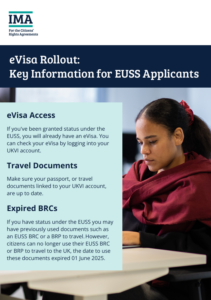
The wording on the image is included below:

eVisa Rollout: Key Information for EUSS Applicants

eVisa Access

If you’ve been granted status under the EUSS, you will already have an eVisa. You can check your eVisa by logging into your UKVI account.

Travel Documents

Make sure your passport, or travel documents linked to your UKVI account, are up to date.

Expired BRCs

If you have status under the EUSS you may have previously used documents such as an EUSS BRC or a BRP to travel. However, citizens can no longer use their EUSS BRC or BRP to travel to the UK, the date to use these documents expired 01 June 2025.

Facing Issues Travelling?

Ask your carrier to contact the Carrier Support Hub if you are unable to demonstrate your permission to travel to your carrier.

You can find more help if you need it on the IMA’s Useful Contacts page.

What Is the IMA Doing?

The IMA has written to the Home Office and will update our communications once we have assured ourselves of their response.

If you have experienced any difficulties travelling, and you are an EUSS applicant, email our dedicated inbox (travel@ima-citizensrights.org.uk) to help us understand what challenges are being faced.


Travel and ETAs What EU Citizens Need to Know

Click the picture or the link  to view the image, share, or download it.

Travel and ETAs What EU Citizens Need to Know

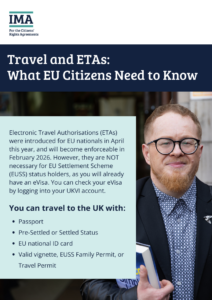
The wording on the image is included below:

Travel and ETAs: What EU Citizens Need to Know

Electronic Travel Authorisations (ETAs) were introduced for EU nationals in April this year, and will become enforceable in February 2026. However, they are NOT necessary for EU Settlement Scheme (EUSS) status holders, as you will already have an eVisa. You can check your eVisa by logging into your UKVI account.

You can travel to the UK with:

  • Passport
  • Pre-Settled or Settled Status
  • EU national ID card
  • Valid vignette, EUSS Family Permit, or
  • Travel Permit

Before You Travel

Make sure your UK Visas and Immigration (UKVI) account records are updated with your travel documents.

Keep your share code ready for any checks.

EU and EEA EFTA citizens with a pending EUSS application will be able to travel when the new ETA system is enforced in February 2026. The Home Office has confirmed that it will use its digital systems to instruct carriers to allow CoA holders to board.

Need help while traveling?

Ask your carrier to contact the Carrier Support Hub.

If you have experienced any difficulties travelling, and you are an EUSS applicant, email our dedicated inbox (travel@ima-citizensrights.org.uk) to help us understand what challenges are being faced.

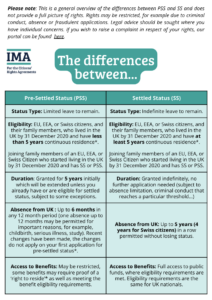
The difference between Pre-Settled Status (PSS) and Settled Status (SS)

Click the picture or the link  to view the image, share, or download it.

The difference between Pre-Settled Status (PSS) and Settled Status (SS)

The wording on the image is included below:

Please note: This is a general overview of the differences between PSS and SS and does not provide a full picture of rights. Rights may be restricted, for example due to criminal conduct, absence or fraudulent applications. Legal advice should be sought where you have individual concerns. If you wish to raise a complaint in respect of your rights, our portal can be found here.

The differences between…

Pre-Settled Status (PSS) Settled Status (SS)
Status Type: Limited leave to remain. Status Type: Indefinite leave to remain.
Eligibility: EU, EEA, or Swiss citizens, and their family members, who lived in the UK by 31 December 2020 and have less than 5 years continuous residence*.

Joining family members of an EU, EEA, or Swiss Citizen who started living in the UK by 31 December 2020 and has SS or PSS.

Eligibility: EU, EEA, or Swiss citizens, and their family members, who lived in the UK by 31 December 2020 and have at least 5 years continuous residence*.

Joining family members of an EU, EEA, or Swiss Citizen who started living in the UK by 31 December 2020 and has SS or PSS.

Duration: Granted for 5 years initially which will be extended unless you already have or are eligible for settled status, subject to some exceptions. Duration: Granted indefinitely, no further application needed (subject to absence limitation, criminal conduct that reaches a particular threshold…)
Absence from UK : Up to 6 months in any 12 month period (one absence up to 12 months may be permitted for important reasons, for example, childbirth, serious illness, study). Recent changes have been made, the changes do not apply on your first application for pre-settled status*. Absence from UK: Up to 5 years (4 years for Swiss citizens) in a row permitted without losing status.
Access to Benefits: May be restricted, some benefits may require proof of a ‘right to reside’* as well as meeting the benefit eligibility requirements. Access to Benefits: Full access to public funds, where eligibility requirements are met. Eligibility requirements are the same for UK nationals.
*‘Continuous residence’ generally means to be in the UK for at least 6 months in any 12-month period.
*Change to Absences: From 16 July 2025, changes have been made for PSS holders who are now permitted to retain their status and apply for settled status if they have lived in the UK for at least 30 months (2 and a half years) during the last 5 years. This change is not applicable to your first application for pre-settled status.
*‘Right to reside’ is a way of describing the conditions of residence, these include being a worker or a retained worker (for example, on maternity leave), being self-employed, having sufficient resources (for example, retired or a student) and comprehensive sickness insurance, being a family member of someone with PSS or SS who meets these conditions, or having already obtained SS

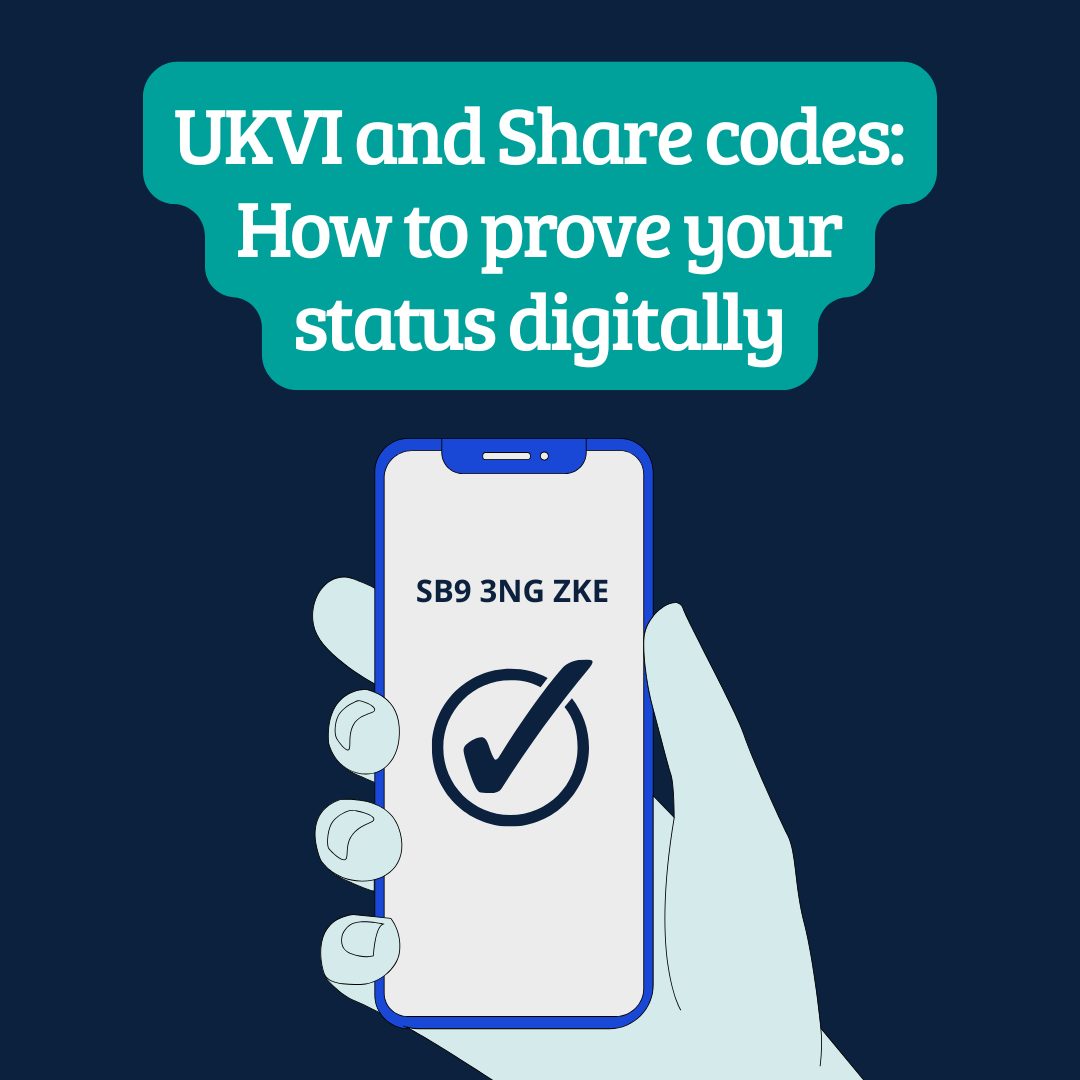
UKVI and Share codes: How to prove your status digitally

Click the picture or the link  to view the image, share, or download it.

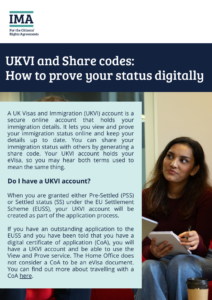
UKVI and Share codes How to prove your status digitally

The wording on the image is included below:

UKVI and Share codes: How to prove your status digitally

A UK Visas and Immigration (UKVI) account is a secure online account that holds your immigration details. It lets you view and prove your immigration status online and keep your details up to date. You can share your immigration status with others by generating a share code. Your UKVI account holds your eVisa, so you may hear both terms used to mean the same thing.

Do I have a UKVI account?

When you are granted either Pre-Settled (PSS) or Settled status (SS) under the EU Settlement Scheme (EUSS), your UKVI account will be created as part of the application process. If you have an outstanding application to the EUSS and you have been told that you have a digital certificate of application (CoA), you will have a UKVI account and be able to use the View and Prove service. The Home Office does
not consider a CoA to be an eVisa document. You can find out more about travelling with a CoA here.

How to access your UKVI account

You can access your UKVI account to update some of your personal details, to generate a share code, or to view your eVisa.

To access your UKVI account, you will need to login with the following details:

  • the identity document you used when creating your account (passport or national ID card)
  • your date of birth
  • phone number or email address you used when creating your account (if you have lost access to your phone or email, you can recover your UKVI account here)

The Home Office has made a helpful video guide.

What is a share code?

A share code is a unique combination of letters and numbers that lets you prove your immigration status. It will look like a combination of letters and numbers. Here is an example share code:

SB9 3NG ZKE

You can write down your share code, screenshot it, print it out, email it, or say the code over the phone.

How to generate your share code

  • login to your UKVI account
  • choose from the list on screen the reason you are sharing your information (for example, to prove your right to work, or to travel)- it is important to choose the correct reason
  • you will then see a preview of the information that will be sharedwhich summarises your immigration status
  • click ‘create share code’

When you travel with PSS or SS

Your eVisa will be checked automatically when you show your identity document to a carrier or border control. Home Office guidance states that you may also be asked to provide additional proof of your immigration status, such as a share code.

Once generated, a share code is valid for 90 days. If you generate your share code before travelling, make sure you do it within 90 days of your return to the UK and carry an offline copy in case you have trouble accessing WIFI at the border. You may want to also bring a copy of the preview page summarising your immigration status so you can easily double check all your details when speaking to carriers and border control.

It is also important that before travelling, you check that:

  • your eVisa shows the correct details
  • your UKVI account is up to date with your most recent passport and personal details
  • your details exactly match the passenger information yougive to your carrier

You will need to make sure that the passport or travel
document you’re using for your journey is added to your UKVI
account.

Keep your details up to date

If any of your identity documents or personal details change, you will need to make sure you update your UKVI account. This will allow you to continue to access your account and prove your immigration status.

Travel changes summary guide

Click the picture or the link to view the image, share, or download it.
Travel changes summary guide

The wording on the image is included below:

Travel to the UK: What EU & EEA EFTA Citizens Need to Know

There have been some substantial changes to travel rules and guidance. This guide is for EU and EEA EFTA citizens and their family members living in the UK
who hold status under the EU Settlement Scheme (EUSS), or have a pending application, known as Certificate of Application (CoA).

We have summarised the key travel changes including changes to Home Office guidance and information on Electronic Travel Authorisation (ETA) enforcement.

Key points at a glance

  • If you have EUSS status, i.e., pre-settled or settled status, you do not need an ETA. You already hold an eVisa which will provide permission to travel for carriers.
  • The Home Office confirmed that from 14 January 2026 non visa nationals with a CoA will have a ‘permission to board’ message when carriers conduct pre-travel checks and, where your UKVI account is linked to your current passportor ID document. You are not required to have an ETA but you may be asked for additional evidence at the UK border.
  • There is no change for visa nationals, who must continue to hold a valid visa or visa exemption document, such as a valid EUSS family permit, to be permitted to travel to the UK, including whilst their EUSS application is pending. A Certificate of Application or Acknowledgement of an Application is not a visa or visa exemption document.
  • Make sure your current passport/ID document is linked to your UKVI account and that you bring the right travel documents with you, including carrying any supporting evidence you may need. If you want to find out more about the evidence requirements, visit: If you’re from the EU, Iceland, Liechtenstein, Norway or Switzerland – GOV.UK
  • If you are unable to update your UKVI account with your new passport or ID document before you travel, you should get a share code using the View and Prove service and be prepared to provide this to carriers if asked.

Timeline

  • 11 Aug 2025 — IMA publicly raises concerns about travel difficulties for EUSS applicants with a CoA, including conflicting guidance and potential problems at the
    border.
  • 24 Dec 2025 — Home Office clarification welcomed: CoA holders will be able to travel (subject to the usual conditions) when ETA enforcement starts in Feb 2026.
  • 30 Jan 2026 — IMA welcomes Home Office intention to remove “do not travel” wording from CoAs issued from 18 Feb 2026; the new advice applies to all CoA holders.
  • 6 February 2026 – GOV.UK updated to reflect that carriers (such as an airline or ferry operator) will be able to confirm that EU and EEA EFTA citizens (and other non-visa nationals) with a CoA have permission to travel.
  • 18 Feb 2026 — CoAs start being issued without “do not travel” text although this change in information applies to all CoA holders.
  • 25 Feb 2026 — ETAs enforced for non-visa nationals including EU and EEA EFTA citizens who do not already have UK immigration status. EUSS status holders and EUSS applicants with a pending application do not need an ETA. CoA holders can board with carrier instruction if their UKVI account is linked to their current travel document.
 
Topic Before After
Guidance to
CoA holders
CoAs and some guidance advised
applicants not to travel while their EUSS
application was pending.
“Advice not to travel” wording
removed on CoAs issued from 18 Feb
2026; new advice applies to all CoA
holders. Evidence requirements at the
border remain unchanged.
CoA holders at
point of boarding
Risk of EU/EEA EFTA citizens with a CoA
being unable to board once ETAs enforced
because they were not eligible for an ETA
and did not hold an alternative digital
permission to travel.
Home Office digital system will notify
carriers to allow boarding of non-visa
national CoA holders from ETA
enforcement date (subject to your
valid ID document being linked to
your UKVI account).
ETA requirement ETAs introduced for EU/EEA EFTA citizens
but not yet enforced. EUSS status holders
do not require an ETA.
ETA enforcement from 25 Feb 2026.
EUSS status holders have never
required an ETA. non-visa national
CoA holders do not need an ETA but
may be required to show additional
evidence at the border.


We’re keen to hear from citizens about their experiences and where they might be having difficulties travelling so we can keep these resources updated with useful information. If you have experienced any difficulties travelling, and you are a CoA holder, please email our dedicated inbox to help us understand what challenges are being faced: travel@ima-citizensrights.org.uk